Discovery of Dark Matter Interaction


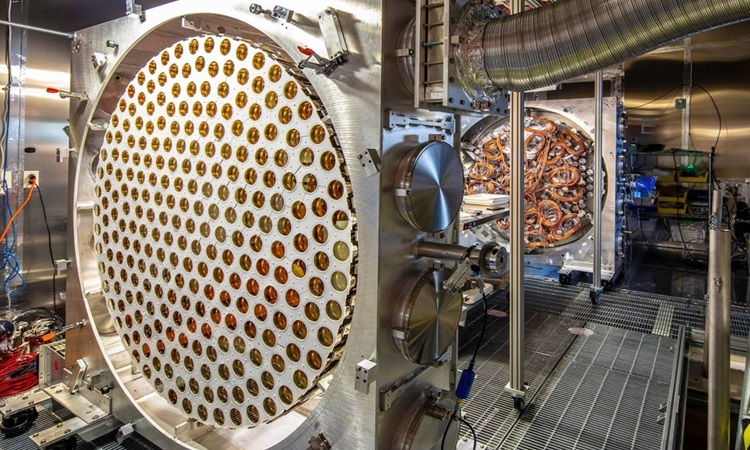
A team of scientists detected a particle interaction 1.5 km deep in South Dakota, potentially caused by dark matter particles known as Weakly Interacting Massive Particles (WIMPs). This finding was reported on September 1, following an experiment conducted on June 16, 2023, using the LUX-ZEPLIN (LZ) detector at the Sanford Underground Research Facility.
Experiment Details
The LZ experiment involved 250 scientists and engineers from 39 organizations, utilizing a detector filled with over 7 tons of ultra-pure liquid xenon. When particles enter the detector, they interact with xenon atoms, producing characteristic light and electron flows that provide information about the incoming particles, including their mass and location.
Statistical Analysis
After analyzing data over 220 days, researchers found a 2.6 sigma confidence level for the interaction, indicating a low probability of error, though the standard for direct detection in particle physics is 5 sigma. The interaction occurred during a time when Earth was moving through a high-density region of dark matter in the galaxy.
Potential Implications
If the detected interaction is indeed from a WIMP, it likely has a mass of at least 200 GeV/c², which is 200 times the mass of a proton. Richard Gaitskell, a physicist involved in the experiment, noted that while the discovery is intriguing, it could also be explained by interactions of ordinary matter not yet fully understood.
Further Research
Additional time and data are needed to confirm the findings. Other experiments in Italy and China are also searching for dark matter using liquid xenon detectors.
Understanding Dark Matter
Dark matter, which constitutes about 85% of the universe’s mass, is invisible and does not interact with light, making it difficult to observe directly. Evidence for its existence primarily comes from gravitational effects on visible matter. The leading theory suggests that dark matter is composed of WIMPs, which have mass and gravitational interaction but weakly interact with ordinary matter. If WIMPs exist, they could pass through Earth without leaving traces, but interactions with atomic nuclei could provide compelling evidence of dark matter’s presence.